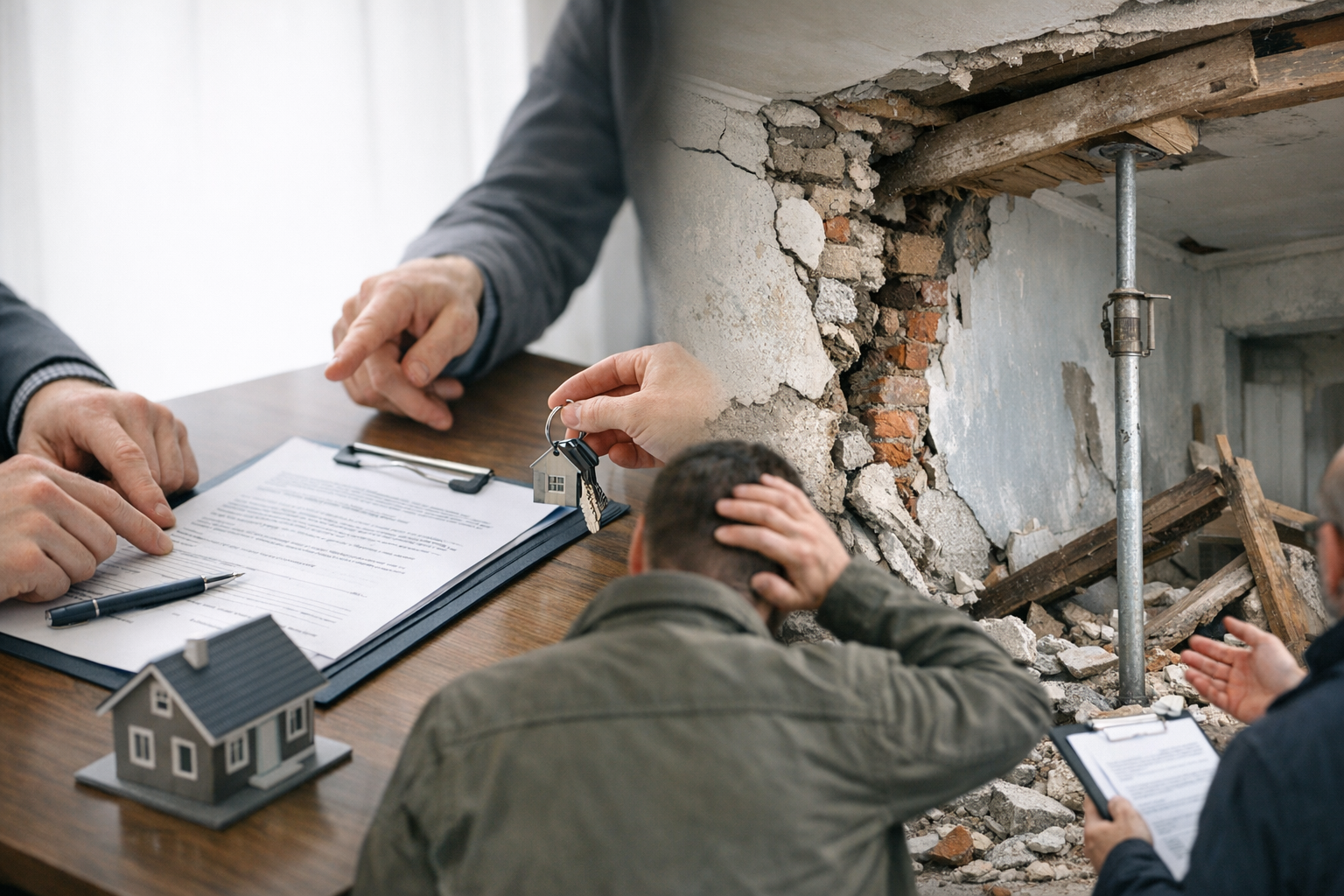


A situation frequently encountered in BSLC's practice begins with a buyer signing a property purchase contract, paying the price and moving in. Several months later, serious structural problems appear, such as cracks in load-bearing walls, subsidence in the foundations or roof leaks. A further expert assessment reveals that the defects existed before the sale but were concealed or left undisclosed by the seller. The central question is then whether the sale can be rescinded and damages claimed.
This is a serious problem because it often affects the property's safety and involves substantial financial loss. Bulgarian law protects buyers of property with hidden defects, but the conditions and procedures require a careful legal approach.
BSLC assists in cases involving the following matters.
- Purchase of a home with hidden structural problems
- Rescission of a property sale because defects were not disclosed
- A damages claim against a property seller
- A property dispute involving hidden defects
- Legal assistance during a purchase and with subsequent problems
When do structural problems qualify as hidden defects under Bulgarian law?
The principal rules are contained in the Bulgarian Obligations and Contracts Act, known as ZZD. Its structure resembles the general contractual rules of continental European law, including the French and German traditions. Articles 193 to 199 ZZD are particularly relevant to property sales involving hidden defects.
Under Article 193(1) ZZD, the seller is liable for defects that substantially reduce the property's value or fitness for use, were unknown to the buyer and could not have been discovered during an ordinary inspection.
A clear distinction is necessary. Not every problem is a hidden defect within the meaning of the law.
First, the defect must have existed when the transaction took place. If the structural problem arose later, for example because of an earthquake or improper use, the seller is not liable.
Second, the defect must objectively have been hidden. Even a reasonable inspection by a buyer without specialist technical expertise would not have revealed it. Typical examples include cracks covered with filler and paint, defects in the building's structure, compromised foundations and recurring leaks that have been temporarily disguised.
Third, the defect must be substantial. Minor cosmetic faults do not justify rescission. Structural problems usually satisfy this requirement because they affect safety and usability.
The seller's knowledge also matters. The law distinguishes between ordinary liability, which applies regardless of whether the seller knew, and more extensive liability where the seller acted in bad faith.
A seller who knew about the defect and failed to disclose it faces greater liability, including liability for all losses.
Proof presents a practical difficulty. In property litigation, the buyer must establish that the defect exists, that it was hidden and that it already existed at the time of the sale.
This is usually done through court-appointed technical expertise, construction records, witness testimony, correspondence and advertisements.
Structural problems almost always require an expert opinion. Without one, a claim against the seller is difficult to establish.
The contract also matters. Notarial deeds often contain clauses stating that the buyer accepts the property in its existing condition. Such clauses do not exclude liability for hidden defects, particularly where there is bad faith. Case law consistently recognises that these agreements do not release a seller from liability for intentional concealment.
Structural problems that were not visible and existed when the sale took place will therefore generally qualify as hidden defects, giving the buyer significant legal protection.
Can the property sale be rescinded and what procedure applies?
Rescission is governed by both the special rules on sale and the general rules on non-performance.
Under Article 195 ZZD, a buyer may rescind the contract or request a price reduction where the defects are substantial.
In cases of serious structural problems, buyers most often seek rescission because the property has become practically unusable or dangerous.
Article 87 ZZD contains the general rules. Rescission is a right capable of changing the legal relationship and is exercised through a declaration or a court claim. For real estate, however, there is a significant feature.
Rescission must take place through the courts. This follows from Article 87(3) ZZD and is confirmed in legal writing and case law.
The buyer must therefore bring proceedings seeking rescission, repayment of the price and, where appropriate, damages.
The procedure involves several important stages.
First, the defect must be established. A technical assessment is usually obtained before proceedings begin.
Second, the seller should be notified. Although prior notification is not always required by law for hidden defects, it is strongly advisable from an evidential perspective.
Third, the claim is filed. The statement of claim must be entered in the Property Register, ensuring that the judgment can be relied on against third parties.
Fourth, the proceedings take place and the court collects evidence, including expert opinions.
Timing also matters. Rights under Articles 193 to 195 ZZD must be exercised within a reasonable time after discovery of the defect. Delay may result in a loss of rights.
The court must also assess whether the non-performance is substantial. Case law recognises that not every breach justifies rescission. It must deprive the buyer of what they were entitled to expect under the contract.
Structural defects almost always satisfy this requirement, especially where the building is dangerous, needs extensive repair or cannot be used for its intended purpose.
The result is return of the property to the seller, repayment of the price to the buyer and restoration of the position before the transaction.
This does not happen automatically. It requires full proof and an appropriate procedural strategy. Early advice from a real estate or civil law specialist is therefore advisable.
What damages can be claimed and how is the loss proved?
Alongside rescission, the buyer may also claim damages. This is especially important for structural defects, where losses often extend beyond the purchase price itself.
The legal basis is again found in ZZD. Where the seller knew about the defect and failed to disclose it, the seller is liable for all losses, both direct and indirect.
These may include repair costs, expert assessment costs, lost profits such as an inability to rent out the property, temporary accommodation and litigation costs.
Liability is considerably broader in cases of bad faith. If the seller acted intentionally, the court may award full compensation.
Proving loss is a separate and complex task. It is not enough to allege that a problem exists. The precise amount of the damage must be established.
Typical evidence includes expert repair estimates, invoices and contracts, bank statements and assessments of the reduction in market value.
Court-appointed technical expertise is particularly important. It examines the nature of the defect, when it arose and the cost of remedying it.
Claims for rescission, repayment of the price and damages are often combined. This provides comprehensive protection within a single set of proceedings.
An alternative is to seek a price reduction rather than rescission. This is appropriate where the defect is serious but repairable and the buyer wishes to retain the property.
The claim then concerns the difference between the price paid and the property's actual value with the defect.
A common mistake is to begin repairs before collecting evidence, making the court case more difficult. The proper sequence is an expert assessment first, followed by remedial action.
Every sale involving hidden defects, particularly structural problems, requires a carefully developed legal strategy. Mistakes at the outset often undermine the prospect of a successful case.
For an assessment of your circumstances, possible claims against the seller and the potential amount recoverable, you can arrange an initial consultation. The legal fees calculator also provides an initial indication of costs to support planning from the outset.