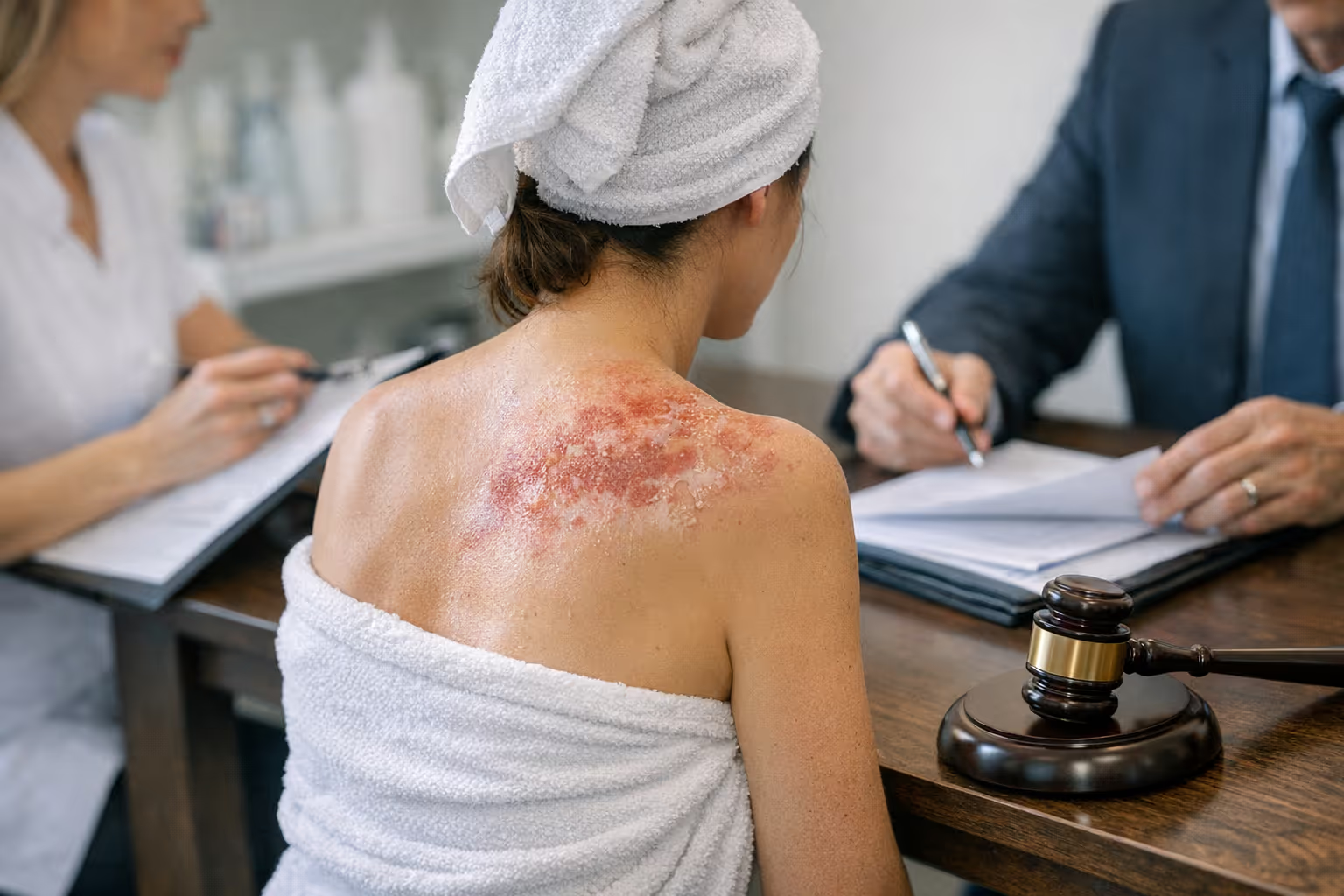


A BSLC client approached us after suffering a facial burn during a laser procedure at a beauty salon. She was initially told that this was a normal reaction, but blisters and pigmentation developed within days and required medical treatment. Her question was a familiar one. Could she claim compensation for harm caused by a cosmetic service, and on what legal basis?
Cases of this kind are not unusual. Although the services may seem routine, their legal consequences can be serious, including liability for bodily injury and non-pecuniary harm. Timely legal advice is essential because proving the damage and its cause requires specific action from the outset.
BSLC assists with burns and medical complications following cosmetic procedures, claims against beauty salons, compensation for bodily injury and non-pecuniary damage, protection of salon clients receiving poor services, and legal representation in injury and damages claims.
When is a beauty salon liable for burns caused by a procedure?
Liability for harm caused by cosmetic services can arise on two main grounds, contractual liability and liability in tort.
The principal legislation is the Bulgarian Contracts and Obligations Act, known as ZZD. It performs functions comparable to contract and tort law in common law systems. Cosmetic services most commonly involve a contract for work under Article 258, where the provider, in this case the salon, undertakes to provide a service with a particular result.
Liability arises where the service is defective or breaches professional standards, safety requirements are not observed, such as through incorrect equipment settings, the client is not informed of risks, or unsuitable or defective products are used.
Contractual liability can follow non-performance or defective performance of the agreement. Tort liability can arise from unlawful injury independently of the agreement.
Under Article 45 of the Act, a person must compensate another for damage they have culpably caused. A salon may therefore be liable even without a written contract if unlawful conduct, damage, causation and fault are present.
The grounds often overlap in practice. An incorrectly performed procedure can be both a breach of a contractual obligation and an unlawful act giving rise to tort liability.
The Supreme Court of Cassation expressly accepts that breach of contract may justify an award for non-pecuniary as well as financial loss. This is particularly important in cosmetic cases, where harm often involves pain, distress and changes in appearance.
How is the harm proved and what compensation can be claimed?
Evidence is the central issue in a claim for bodily injury after a cosmetic procedure.
It is necessary to establish the injury, such as a burn, scarring or pigmentation, unlawful conduct in the form of an error during the procedure, a causal link between the procedure and the injury, and fault, whether intentional or negligent.
Pecuniary loss includes medical expenses, medication and lost earnings. Non-pecuniary harm includes pain, suffering, psychological discomfort and disfigurement.
Under Article 52 of the Contracts and Obligations Act, the court assesses non-pecuniary damages on the basis of fairness. There are no fixed amounts. The court examines the particular circumstances, including the severity of the burn, recovery time, permanent scars and the effect on mental wellbeing and social life.
Important evidence includes medical records such as discharge summaries and expert reports, photographs taken before and after the procedure, witness accounts, records of the service such as a receipt or appointment booking, and expert evidence on the cause of the injury.
A common mistake is waiting for the injury to resolve by itself. This makes proof more difficult because early medical records are missing.
Compensation may also be sought for temporary injuries without permanent scars, harm to appearance such as disfigurement, and psychological suffering even without severe physical trauma.
What steps are involved in bringing a claim against a beauty salon?
Protection begins well before the lawsuit. A sound strategy significantly improves the prospects of success.
The first step is collecting evidence, including an immediate medical examination and documentation of the condition. Without medical confirmation, the claim is difficult to prove.
The next step is usually an out-of-court demand to the salon setting out the facts, the harm suffered and the compensation requested.
Many disputes can be settled voluntarily, particularly where the salon has professional liability insurance under Article 469 of the Bulgarian Insurance Code.
If no settlement is reached, court proceedings follow. The claim usually seeks an award under Article 45 of the Contracts and Obligations Act for a tort or compensation for breach of contract.
Under Article 124, paragraph 1 of the Civil Procedure Code, proceedings seek recognition and protection of an infringed right, including an award of compensation.
Practical preparation includes a legal assessment, collection and organisation of evidence, a court-appointed medical examination and submission of the claim to the competent court.
Frequently underestimated risks include insufficient evidence linking the procedure to the injury, signed consent forms that do not release liability for negligence, and identifying the wrong defendant, such as suing an individual instead of the company.
The limitation period also matters. In principle, compensation claims under the Contracts and Obligations Act are subject to a 5-year period, but delay always weakens the claimant's position.
A consultation with a civil law lawyer is practically necessary to assess the proper legal basis and evidential strategy. You can obtain an initial indication of costs through the legal fees calculator or book a consultation about a cosmetic treatment dispute.
A burn following a cosmetic procedure may amount to a legally actionable injury. Bulgarian law provides effective remedies, but success depends on prompt action, the correct legal classification and strong evidence.