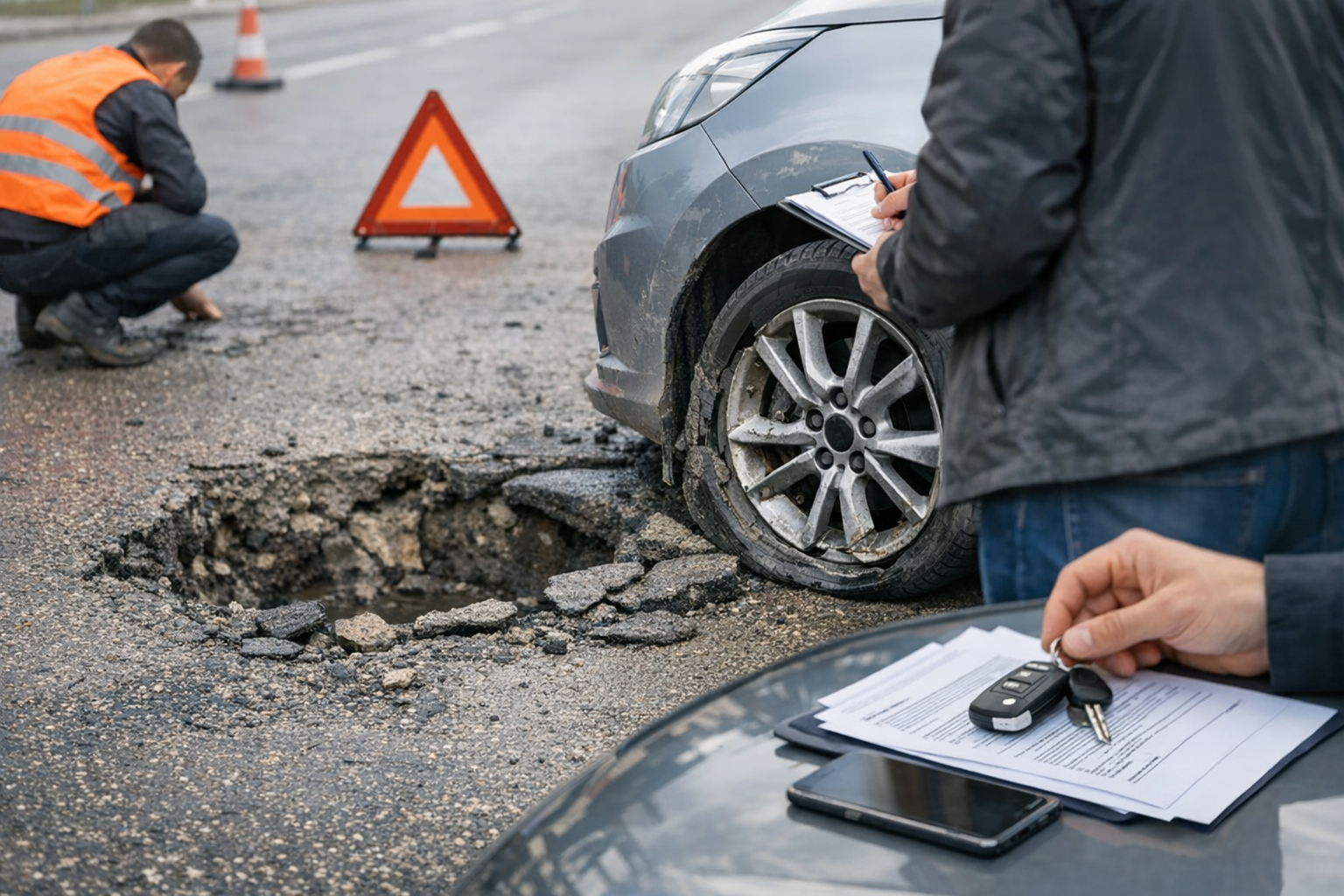


Clients often come to BSLC after what initially seems a minor incident, such as a punctured tyre and a bent wheel rim after driving over an unmarked pothole on a city street. One client was convinced that it was not worth pursuing because the damage amounted to around BGN 600. A brief assessment showed that he was entitled to compensation and that the municipality could be held liable even though it was unclear which individual employee had failed to arrange the repair.
Such incidents are common and directly affect car owners' rights. The issue goes beyond repairing the vehicle. It also concerns whether the loss can be recovered and who must pay for it. With properly collected evidence and timely action, a vehicle damage claim may be entirely justified.
BSLC provides assistance with the following matters.
- Damage to a car caused by a pothole or an uneven road surface 🚗
- Claims against a municipality for damage arising from road infrastructure
- Proving the causal link between the road condition and the damage
- Protecting a car owner's rights following property damage
- Negotiations with an insurer or preparation of a court claim
Who is liable for car damage caused by a pothole?
Liability in these cases is not an abstract concept. Bulgarian law regulates it clearly, and it usually rests with the owner or the body responsible for managing the road.
The principal legal mechanism is liability in tort under the Bulgarian Obligations and Contracts Act, known by its Bulgarian abbreviation ZZD. The provisions most frequently applied are the following.
- Article 45 ZZD, which establishes the general rules on liability in tort
- Article 49 ZZD, which provides for the liability of a person who entrusts work to others for damage caused by those performing it
Under Article 49 ZZD, a person who entrusts work to someone else is liable for damage caused during or in connection with its performance. This is particularly significant for road infrastructure. Even where the individual employee at fault has not been identified, the legal entity, such as the municipality, remains liable.
In practical terms, responsibility is allocated as follows.
- The relevant municipality is responsible for municipal roads.
- The Road Infrastructure Agency is responsible for national roads.
- The owner is responsible for private roads and car parks.
The duty to maintain a road includes routine repairs, warning signs where hazards exist and measures to make uneven surfaces safe.
Where a road is in poor condition and creates a traffic risk, failure to fulfil these duties constitutes an unlawful omission.
It is important to understand that there is no need to establish the personal fault of an identified employee. The following circumstances are sufficient.
- A defect in the road, such as a pothole, exists.
- The defect has not been marked or repaired.
- Damage has occurred.
This explains why properly prepared claims against municipalities are relatively often successful.
How can you prove that the pothole caused the damage?
This is the most critical issue in such proceedings. Damage to the vehicle alone is not enough. A causal link must be established between the condition of the road and the loss.
In practice, the case is built through a combination of evidence.
- A traffic police report, if officers attended
- Photographs of the pothole and the scene
- Photographs of the damage to the vehicle
- Witness testimony
- An automotive technical expert assessment
- Repair documents, including invoices and receipts
It is essential to show that the pothole actually existed when the incident occurred, that its dimensions were capable of causing the particular damage and that there were no warning signs.
One of the most common problems is that drivers fail to document the incident promptly. This considerably weakens their position.
Typical mistakes include leaving the scene without taking photographs, having no witnesses, arranging repairs without supporting documents and submitting a claim late.
The court will often appoint an expert to determine whether the particular damage could have occurred in the manner described. This can be decisive. If the expert's findings do not support the allegations, the claim may be dismissed.
A useful practical approach is to treat the incident as a potential court case from the outset.
When and how can a compensation claim be brought?
The right to compensation arises when all the elements of liability in tort are present.
- Unlawful conduct in the form of an inadequately maintained road
- Loss in the form of damage to the vehicle
- A causal link
- Fault, which is presumed in the context of Article 49 ZZD
Compensation covers all property losses, including repair costs, replacement parts, any necessary vehicle recovery and other directly related expenses.
The process usually starts outside court. A written claim is submitted to the municipality or the Road Infrastructure Agency, supporting evidence is supplied and a response is awaited.
If no voluntary payment is made, the matter can proceed to court.
The time limit for bringing a claim is 5 years under the general limitation period in the Obligations and Contracts Act.
It is important to assess whether the evidence is sufficient, whether the amount of the damage justifies litigation and whether an out-of-court settlement is possible.
Many clients first approach their insurer if they have comprehensive motor insurance, commonly known in Bulgaria as Casco. After paying compensation, the insurer may bring a recovery claim against the responsible institution.
The costs of proceedings include the court fee, expert assessments and legal fees.
You can obtain an initial indication of costs through this legal fees calculator. This can help you decide whether to start proceedings.
In more complicated cases, such as a dispute over who maintained the road or what caused the damage, an early consultation with a lawyer is advisable, particularly within the firm's civil law practice.
Damage caused by a pothole is therefore more than a problem for the driver alone. It raises a legal question about the responsibility of the bodies required to keep road infrastructure safe. With the right approach, compensation is entirely achievable.