


.svg)
In everyday life, a property boundary often looks deceptively simple — a line on the cadastral map, a fence on the ground, or a hedge separating two plots 🌿. In legal reality, however, boundaries are one of the most common sources of serious disputes between neighbors, developers, and landowners in Bulgaria. Problems arise when a boundary is inaccurately measured, poorly documented, or does not correspond to the applicable zoning or regulation plan.
A typical situation looks like this: a neighboring owner begins construction, placing a building or extension one meter away from what they believe to be the boundary. Only later does it become clear that the construction encroaches on your land. At that moment, the issue is no longer technical — it becomes legal. You may need to distinguish between a cadastral (property) boundary and a regulatory (planning) boundary, request official surveying and marking, and potentially initiate court proceedings to have the boundary legally established.
Under Article 109 of the Bulgarian Ownership Act, the owner of a property may require any person who unlawfully interferes with the exercise of ownership rights to cease those actions. When the interference results from an unclear or disputed boundary, however, Bulgarian law provides a specific procedural remedy — a claim for determination of boundaries under Article 109a of the Ownership Act. In such proceedings, the court appoints a licensed expert surveyor who identifies and marks the precise boundary line between neighboring properties ⚖️.
This is where many owners discover a crucial legal reality: the property boundary and the regulatory boundary do not always coincide, particularly in areas governed by older development plans or incomplete cadastral data.
A key practical issue concerns construction setbacks. Under Article 31, paragraph 1 of the Spatial Development Act, the minimum distance from a building to a lateral regulatory line is generally three meters. This distance is measured from the regulatory boundary, not necessarily from the cadastral or historically used property line. When these lines differ, misunderstanding them can lead to unlawful construction, administrative sanctions, and civil disputes.
Adding to the confusion, many owners rely on mobile applications or informal GPS measurements as preliminary guidance 📱. While such tools may offer orientation, they have no legal value. Only licensed geodetic surveying and official cadastral data are legally binding. As a result, property owners often find themselves navigating multiple procedures, institutions, and legal regimes — including cadastral law, zoning law, and specific rules governing inter-neighbor boundaries.
BSLC assists clients not only with legal strategy — drafting claims and representing them in boundary disputes — but also with the practical coordination between cadastral authorities, municipalities, and licensed surveyors. Our approach is comprehensive: from verifying the current cadastral status of a property to organizing official boundary marking and, when necessary, pursuing judicial protection. Because a property boundary is not merely a line on the ground — it is legally protected space that requires professional defense 🛡️.
What are the Cadastre and the Property Register in Bulgaria, and why are they crucial in property boundary disputes?
In Bulgaria, the Cadastre and the Property Register are two separate but closely connected public registers, each serving a different legal function, and understanding the distinction between them is essential — especially for foreign property owners.
The Cadastre (maintained by the Geodesy, Cartography and Cadastre Agency) is a technical register. It shows the physical characteristics of real estate: location, boundaries, surface area, coordinates, purpose of land, and the graphical representation of each property on the cadastral map. In boundary disputes, the Cadastre answers the question “Where is the property and where do its borders lie?” 📐 However, it does not create ownership rights — it only reflects them.
The Property Register (maintained by the Registry Agency) is a legal register. It records ownership rights and other real rights over property, such as mortgages, easements, usufruct, leases subject to registration, court judgments, and enforcement actions. It answers the question “Who owns the property and what legal burdens exist over it?” 🏛️ Rights become opposable to third parties only after registration here.
This distinction is critical because a property may be correctly owned but incorrectly mapped, or correctly mapped but legally encumbered. In boundary disputes, courts and authorities examine both registers together — the Cadastre to determine the physical extent of the land, and the Property Register to verify ownership and the chronology of rights. For foreign buyers, relying on only one of the two can lead to serious legal risks, including loss of land, inability to build, or disputes with neighbors or the state.
At BSLC, we always conduct a combined cadastral and registry analysis, ensuring that what you see on the map matches what the law recognizes — because in Bulgarian property law, technical accuracy and legal validity must go hand in hand ⚖️.
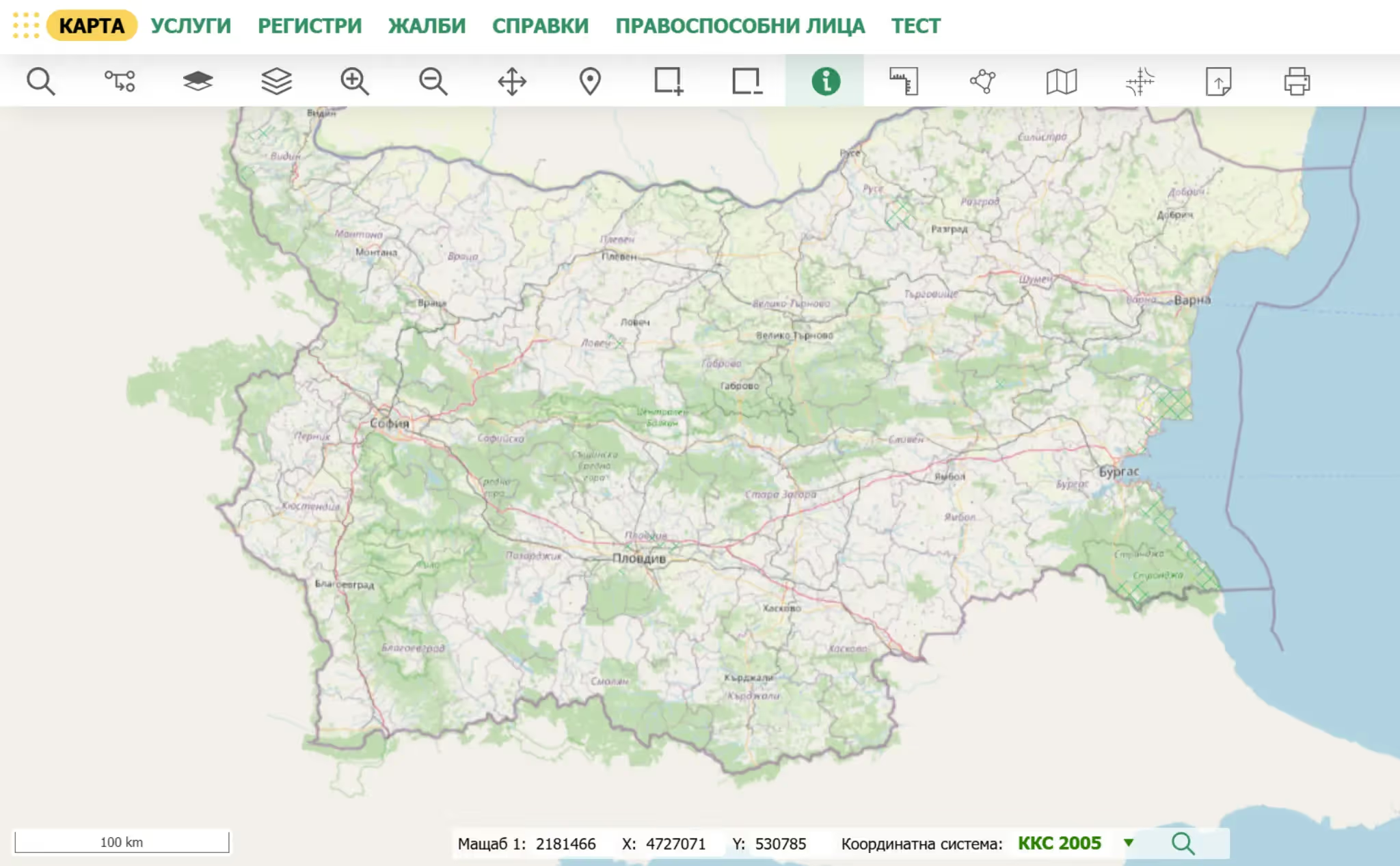
How are property boundaries determined in Bulgaria?
Determining the boundary of a real estate property in Bulgaria depends on several factors: whether a cadastral map exists, whether a zoning (regulation) plan applies, whether there are court decisions or administrative acts, and how consistent the available documentation is. The process combines legal analysis with technical surveying and most often becomes relevant during construction, fencing, subdivision, or neighbor disputes.
Under Article 49, paragraph 1 of the Cadastre and Property Register Act, property boundaries are defined in the cadastral map based on geodetic surveys, legal title documents (notarial deeds, court decisions), and other admissible evidence. Where a cadastral map exists, it has mandatory legal force and serves as the official reference for property boundaries.
If there is a discrepancy between actual land use and cadastral data, the interested party must initiate a correction procedure or, in the event of a dispute, file a claim — for example under Article 54, paragraph 2 of the Cadastre Act in cases of an obvious cadastral error.
Where a detailed zoning plan applies, construction and fencing must comply with regulatory lines, not cadastral ones. This distinction is frequently misunderstood by foreign owners. In such cases, Article 31 of the Spatial Development Act governs permissible distances, making regulatory boundaries decisive for construction legality.
When no cadastral map exists, or when documents conflict, boundaries may be established through official surveying by a licensed geodesist using historical plans, land restitution materials, or prior sketches. In limited cases, neighbors may voluntarily agree on a boundary, document the agreement, and request cadastral amendment — though this requires careful legal drafting to avoid future disputes.
If technical and administrative avenues fail, judicial protection becomes necessary. Courts may establish boundaries through claims under Article 43, paragraph 3 or Article 54, paragraph 2 of the Cadastre Act, or exceptionally under Article 109a of the Ownership Act. The court’s decision, based on documentary evidence and expert reports, has binding legal effect.
BSLC supports clients at every stage — legal assessment, document verification, coordination of surveying, and litigation where required. The goal is always the same: a precise, legally secure, and sustainable determination of your property boundary.
What legal claims exist to protect and establish property boundaries?
Boundary disputes are rarely “just technical.” They usually reflect deeper legal uncertainty about ownership, documentation, or historical land use. Bulgarian law provides several distinct claims, each applicable to different factual and procedural scenarios.
Claim for determination of boundaries under Article 109a of the Ownership Act
Article 109a allows a property owner to request judicial determination of boundaries between their land and neighboring properties. Despite its broad wording, case law strictly limits its use. The claim is admissible only when no other legal or technical means exist — such as a cadastral map, zoning plan, land division plan, or restitution sketch.
This is a real (in rem) claim and may be brought only by an owner. The defendant is the owner of the adjacent property. The court does not create new boundaries but establishes the legally existing one based on evidence. Because of the developed cadastral system in Bulgaria, this claim is now used only as a last resort, mainly in rural or historically unregulated areas.
Claim during creation of a new cadastral map – Article 43(3) of the Cadastre Act
This positive declaratory claim arises while a cadastral map is being created. If a boundary dispute emerges during initial surveying, the cadastral authority must suspend the process until the court resolves the dispute.
The claim establishes ownership over the disputed area so that the boundary can be correctly reflected in the new map. It may be brought by owners, co-owners, or even creditors acting under Article 134 of the Obligations and Contracts Act. The court’s final decision becomes the basis for completing the cadastral records.
BSLC frequently applies this mechanism in suburban or restituted areas where documentation is fragmented and overlapping.
Claim for correction of existing cadastral boundaries – Article 54(2) of the Cadastre Act
When a cadastral map already exists but contains inaccuracies, the appropriate remedy is a claim for correction due to an obvious factual error. Such errors arise when the map does not reflect boundaries derived from valid legal documents.
This claim requires proof of ownership and submission of a correction project prepared by a licensed surveyor. Once the court confirms the correct boundary, the cadastral authority must amend the map accordingly. This procedure is critical for future sales, construction permits, and enforcement of ownership rights.
BSLC provides end-to-end assistance — from legal preparation to technical coordination — ensuring that both the legal and cadastral aspects of the correction are properly addressed.

.svg)
.svg)